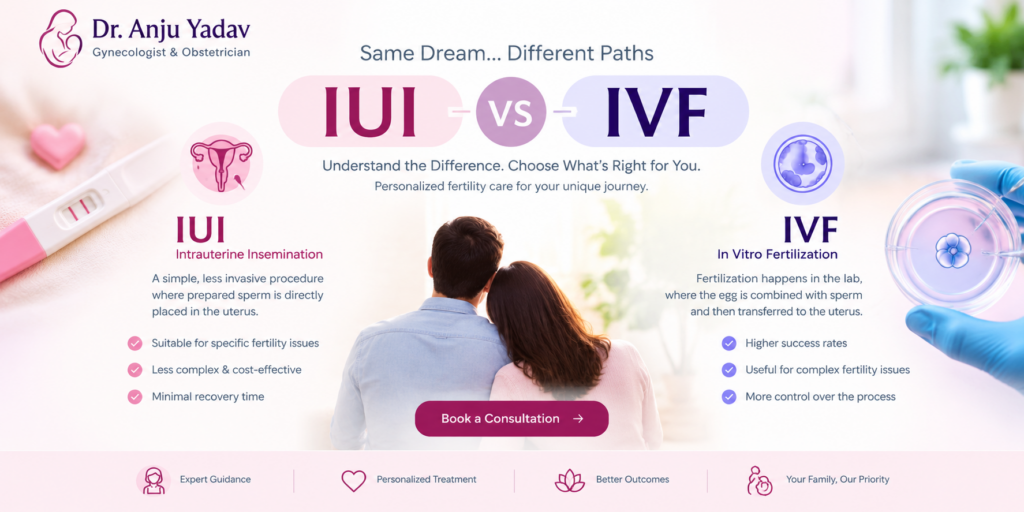
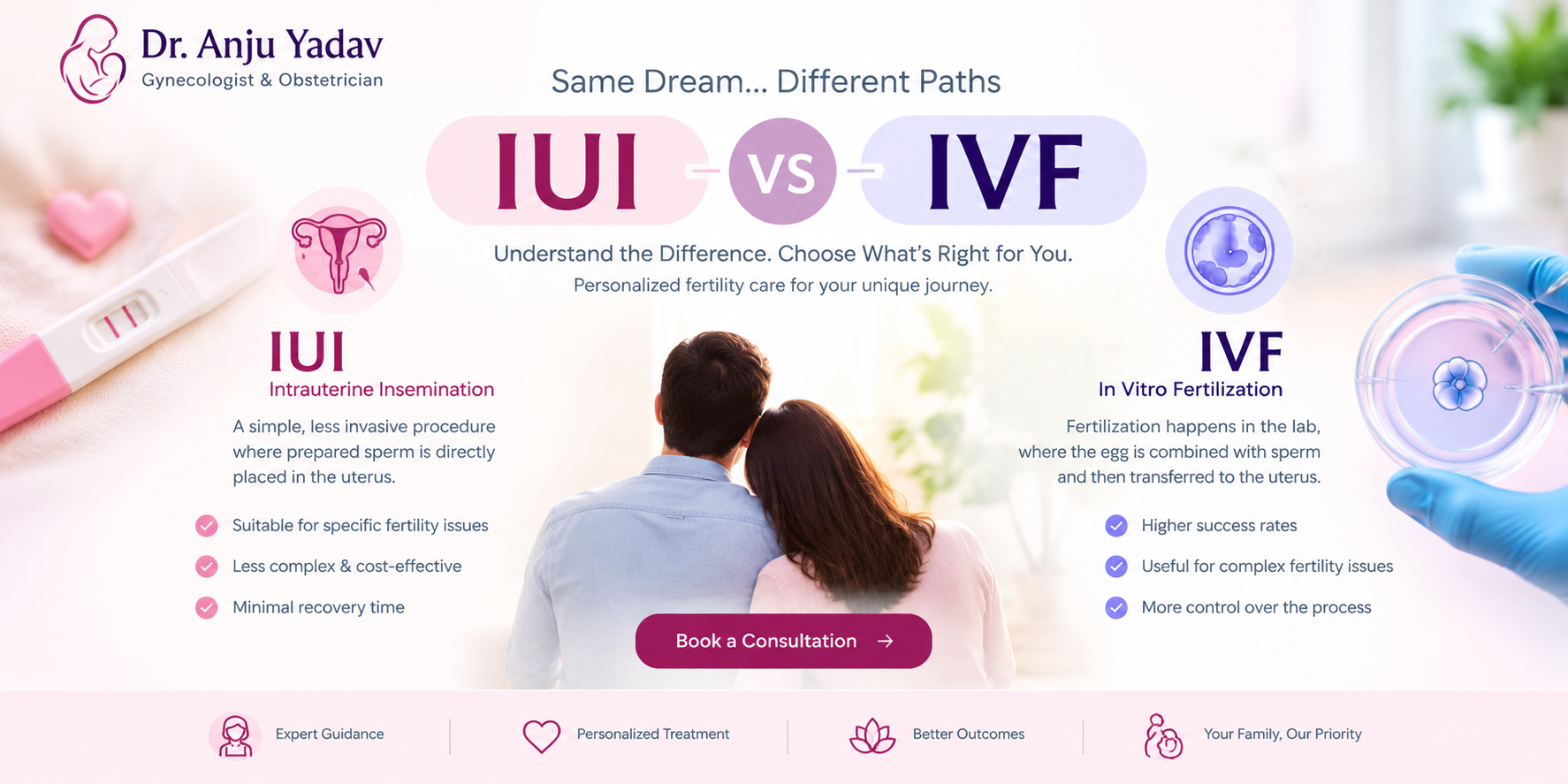
If you have been trying to conceive for a while without success, you have probably come across two terms again and again: IUI and IVF. Both are well-established fertility treatments, but they work very differently, and the right choice depends on your age, diagnosis, and medical history.
This guide explains IUI vs IVF in simple terms, so you can walk into your consultation informed and confident.
What Is IUI (Intrauterine Insemination)?
IUI is a simpler, less invasive fertility treatment. A concentrated sample of healthy sperm, washed and prepared in the laboratory, is placed directly into the uterus around the time of ovulation. This shortens the distance sperm must travel to reach the egg and improves the chance of fertilisation.
Fertilisation still happens inside the body. IUI is often combined with mild ovulation-stimulating medicines so that one or two good eggs are released. You can read more about the procedure on our Intrauterine Insemination (IUI) page.
What Is IVF (In Vitro Fertilisation)?
In IVF, eggs are retrieved from the ovaries after hormonal stimulation and fertilised with sperm in the laboratory. The resulting embryos are grown for a few days, and a healthy embryo is transferred into the uterus.
When sperm quality is a concern, a technique called ICSI is used. A single healthy sperm is injected directly into a mature egg. You can learn more about it on our IVF-ICSI page.
Key Differences Between IUI and IVF
| Factor | IUI | IVF |
|---|---|---|
| Where fertilisation happens | Inside the body | In the laboratory |
| Invasiveness | Minimal | More involved (egg retrieval, embryo transfer) |
| Medication | Mild or none | Stronger hormonal stimulation |
| Cost | Lower per cycle | Higher per cycle |
| Success per cycle | Generally lower | Generally higher |
| Best suited for | Mild or unexplained infertility | Blocked tubes, low ovarian reserve, severe male factor, repeated failures |
When Is IUI Recommended?
IUI is usually a good first step if:
- You have unexplained infertility with normal test results
- Your fallopian tubes are open and healthy
- The male partner has mildly reduced sperm count or motility
- You have ovulation problems that respond well to medication
- You have cervical factor issues or mild-to-moderate endometriosis
- You are using donor sperm, or have difficulties with intercourse
For suitable couples, success rates per IUI cycle are generally modest, often cited in the range of 10–20%. Most doctors recommend 3 to 4 cycles before considering a change in approach.
When Is IVF Recommended?
IVF is generally advised when:
- Both fallopian tubes are blocked or damaged
- There is severe male factor infertility (very low count, poor motility or morphology)
- The woman is above 35 or has low ovarian reserve
- There is moderate to severe endometriosis
- IUI has been tried several times without success
- You have had recurrent miscarriages or need genetic screening of embryos through Preimplantation Genetic Testing
- You want to freeze embryos or eggs for the future
IVF generally gives a higher chance of pregnancy per cycle, and the lab stage lets your doctor see and select healthy embryos. Success depends heavily on the woman’s age, egg quality, and the underlying cause of infertility.
How Age Affects Your Choice
Age is one of the biggest factors. Women under 30 with mild issues may reasonably try IUI first. After 35, egg quantity and quality decline faster, and time becomes critical. Spending months on several IUI cycles may not be the best use of time, so many specialists suggest moving to IVF earlier.
What About the Cost?
IUI costs less per cycle, but several cycles can add up. IVF costs more upfront but may offer better chances per attempt. Costs vary by clinic, medicines, and the techniques used, so ask for a clear estimate during your consultation rather than comparing headline numbers alone.
Can You Start With IUI and Move to IVF?
Yes. Many couples begin with IUI and move to IVF if they do not conceive after a few cycles. However, for some diagnoses, such as blocked tubes or severe sperm problems, IUI is unlikely to work, and going straight to IVF saves time, money, and emotional strain. A complete fertility workup (hormone tests, ultrasound, tubal assessment, and semen analysis) is the only reliable way to decide.
Questions to Ask Your Fertility Specialist
- What is the exact cause of our infertility?
- Based on our age and reports, what is our realistic success rate with each option?
- How many IUI cycles do you recommend before reassessing?
- What are the risks, including multiple pregnancy or ovarian hyperstimulation?
- What will each option cost in total?
Frequently Asked Questions
Is IUI painful?
Most women feel only mild cramping, similar to a Pap smear. The procedure takes a few minutes and needs no anaesthesia.
Is IVF safer than IUI?
Both are generally safe when done by an experienced specialist. IUI with strong medication can raise the chance of twins or more, while IVF allows control over how many embryos are transferred.
How soon can I take a pregnancy test after IUI or IVF?
Usually about two weeks after the procedure. Your doctor will give you the exact date.
Does IVF guarantee a baby?
No treatment can guarantee pregnancy. A good specialist will give you honest, personalised expectations.
Final Thoughts
There is no single “better” option in the IUI vs IVF debate. The right treatment is the one that matches your diagnosis, age, and timeline. A thorough evaluation by an experienced specialist is the best first step.
Consult a Fertility Specialist in Gurugram
If you are unsure whether IUI or IVF is right for you, Dr. Anju Yadav, a fertility specialist with over 17 years of experience, can review your reports and recommend a personalised plan.
📍 Nouveau Medics Multispeciality Clinic, Sector 83, Gurugram
📍 Cloudnine Hospital, Sector 47, Gurugram
📞 8800650611