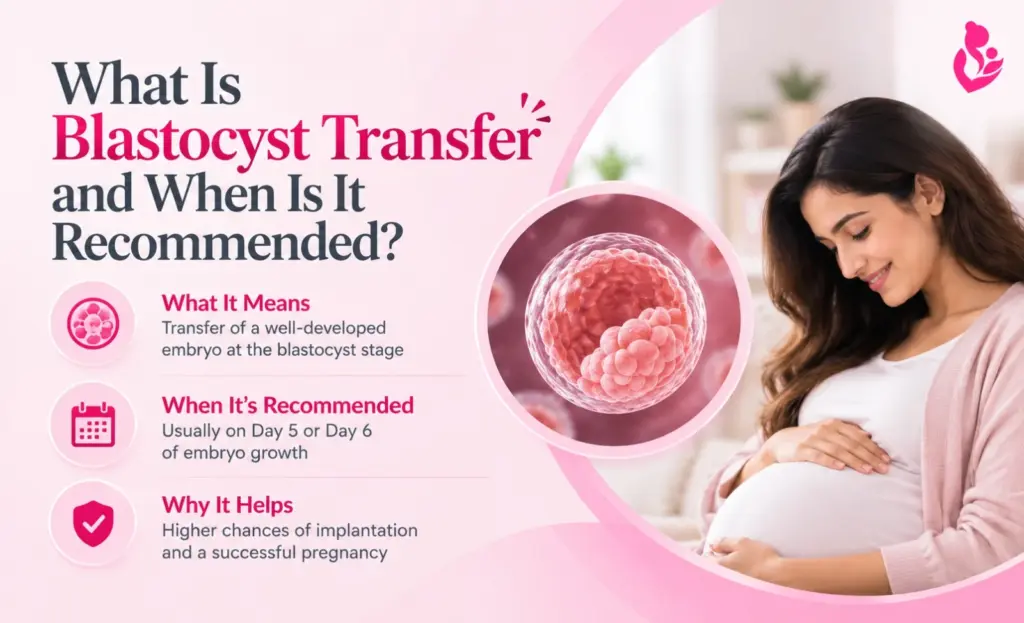
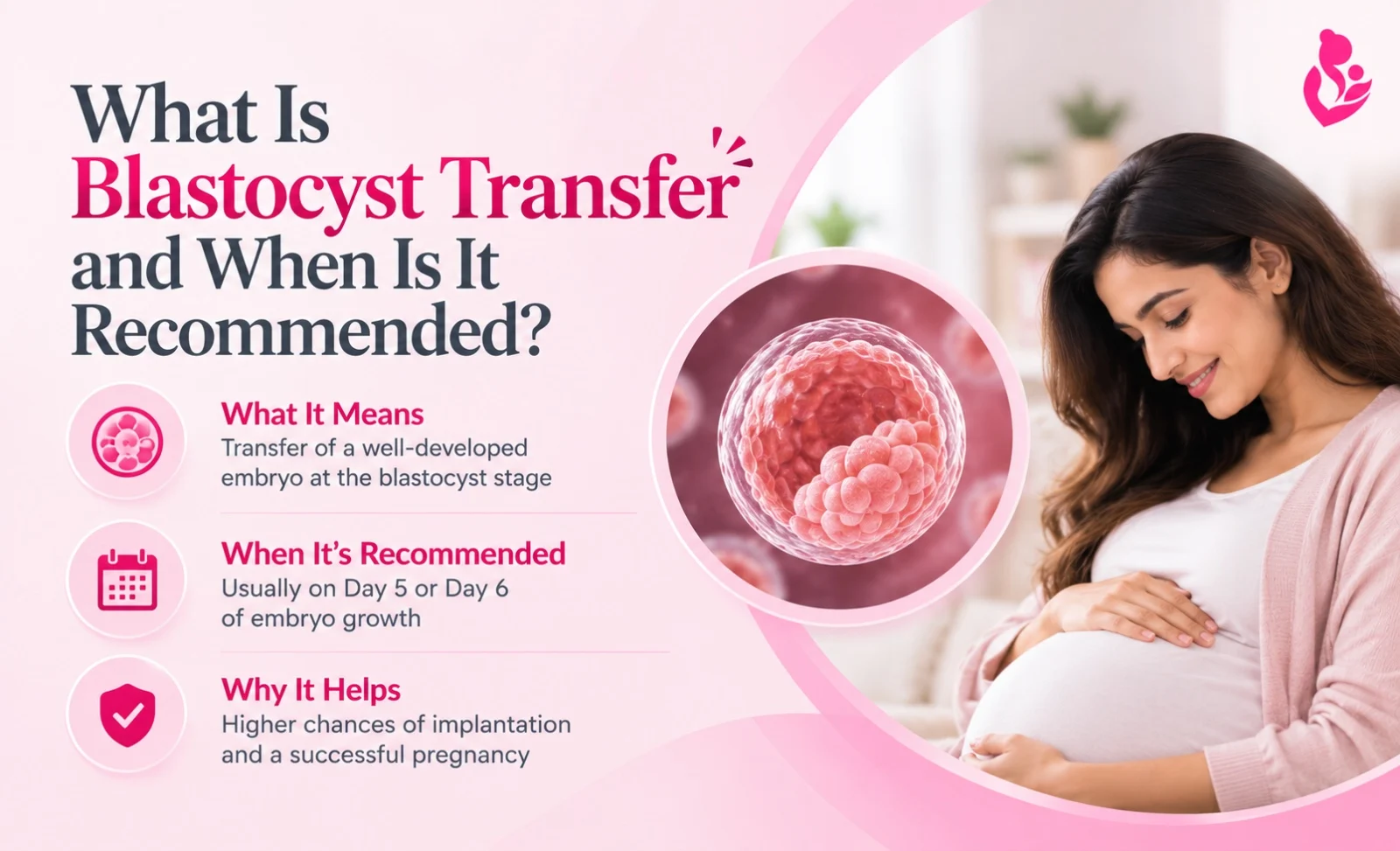
A blastocyst transfer is an IVF procedure in which a fertilised egg is cultured in the laboratory for about 5-6 days until it reaches the blastocyst stage before being transferred into the uterus. Compared with an earlier Day-3 transfer, blastocyst culture gives the embryology team more time to observe embryo development and select an embryo suitable for transfer.
What Is a Blastocyst?
A blastocyst is an embryo that has developed for approximately five to six days after fertilisation. At this stage, it has a more organised structure and consists of:
- Blastocoel: A fluid-filled cavity that develops within the embryo.
- Inner cell mass (ICM): The group of cells that develops into the fetus.
- Trophectoderm: The outer layer of cells that contributes to the formation of the placenta.
- Expanded cell structure: A blastocyst generally contains many more cells than a Day-3 embryo.
- Implantation readiness: In natural conception, an embryo reaches the uterus around the blastocyst stage, when it can begin the process of implantation.
How Does Blastocyst Transfer Work?
Blastocyst transfer is performed as part of an IVF cycle. The general process includes:
- Ovarian stimulation: Medicines are used to stimulate the ovaries to develop multiple follicles.
- Egg retrieval: Mature eggs are collected through an egg retrieval procedure.
- Fertilisation: The eggs are fertilised with sperm in the laboratory, using conventional IVF or ICSI when indicated.
- Embryo culture: The resulting embryos are monitored as they develop in the laboratory.
- Blastocyst development: Embryos that continue developing may reach the blastocyst stage around Day 5 or Day 6.
- Embryo selection: The fertility team evaluates the available blastocysts and selects an appropriate embryo for transfer.
- Embryo transfer: The selected blastocyst is placed inside the uterus using a thin catheter.
Not every embryo that develops after fertilisation will reach the blastocyst stage. Therefore, extended embryo culture may sometimes result in fewer embryos being available for transfer or freezing.
When Is Blastocyst Transfer Recommended?
The decision to transfer a blastocyst depends on factors such as embryo development, the number and quality of embryos available, previous IVF outcomes, age, and whether genetic testing is planned.
1. When Multiple Embryos Are Available
Blastocyst culture may be considered when several embryos are developing well. Allowing embryos to continue developing in the laboratory can provide additional information about which embryos successfully reach the blastocyst stage.
2. After Previous IVF or Day-3 Transfer Failures
For some patients who have experienced unsuccessful earlier embryo transfers, a fertility specialist may consider blastocyst culture and transfer as part of a revised IVF strategy.
However, the decision should be based on the individual’s fertility history rather than simply assuming that a blastocyst transfer will be more successful.
3. When Preimplantation Genetic Testing Is Planned
Preimplantation Genetic Testing (PGT) is generally performed using cells taken from the trophectoderm of a blastocyst. The embryo can then be frozen while the genetic testing is performed, with transfer planned later when clinically appropriate.
4. When Single Embryo Transfer Is Preferred
Blastocyst culture can support single embryo transfer, where one embryo is transferred instead of multiple embryos. The goal is to reduce the risk of multiple pregnancy while maintaining an appropriate chance of pregnancy based on the patient’s individual circumstances.
5. When Embryo Selection Is Important
Culturing embryos to Day 5 or Day 6 allows embryologists to observe their development for a longer period. This can provide additional information when selecting an embryo for transfer or freezing.
Blastocyst Transfer vs Day-3 Embryo Transfer
| Feature | Day-3 Embryo Transfer | Blastocyst Transfer |
| Timing | Around 3 days after fertilisation | Around 5–6 days after fertilisation |
| Development stage | Cleavage-stage embryo | Blastocyst |
| Laboratory culture | Shorter | Longer |
| Embryo selection | Based on earlier development | More time available to observe development |
| PGT | Not usually the stage used for biopsy | Common stage for embryo biopsy |
| Embryos available | More embryos may be available earlier | Some embryos may stop developing before reaching blastocyst |
| Transfer approach | May involve one or more embryos depending on the clinical plan | Often facilitates single embryo transfer |
What Are the Benefits of Blastocyst Transfer?
Potential advantages of blastocyst transfer in IVF include:
- Provides additional time to observe embryo development.
- Can help identify embryos that successfully reach the blastocyst stage.
- Allows trophectoderm biopsy when PGT is indicated.
- Can support a single embryo transfer approach.
- More closely corresponds to the developmental stage at which an embryo normally reaches the uterus during natural conception.
However, blastocyst culture is not automatically the best option for every IVF patient. Some embryos may not continue developing to Day 5 or Day 6, which can leave fewer embryos available for transfer or freezing.
What Are the Risks or Limitations of Blastocyst Transfer?
Blastocyst transfer is generally a well-established IVF procedure, but it has some limitations:
- Not every embryo reaches the blastocyst stage.
- Some embryos may stop developing during extended laboratory culture.
- There may be no blastocyst available for transfer in some cycles.
Is Blastocyst Transfer Better Than Day-3 Transfer?
Blastocyst transfer is not universally better than Day-3 embryo transfer. The appropriate transfer stage depends on factors such as the number of embryos available, embryo development, maternal age, previous IVF history, whether PGT is planned and the fertility specialist’s assessment.
A fertility specialist can help determine whether Day-3 transfer, blastocyst transfer, frozen embryo transfer, or another IVF strategy is appropriate for an individual patient.
Blastocyst Transfer and Frozen Embryo Transfer
A blastocyst can be transferred during a fresh IVF cycle or frozen for a later frozen embryo transfer (FET).
When PGT is performed, embryos are generally frozen after biopsy while the genetic testing is completed. A suitable embryo may then be transferred in a subsequent cycle.
The decision between fresh and frozen transfer depends on factors including hormonal levels, uterine lining, ovarian response, embryo availability and the overall treatment plan.
Blastocyst Transfer With Dr. Anju Yadav
Choosing the right embryo transfer strategy is an important part of IVF treatment. Dr. Anju Yadav, a fertility specialist, provides personalised fertility evaluation and IVF care based on the patient’s reproductive history, embryo development and treatment requirements.
If you are considering blastocyst transfer after IVF, discussing the number and quality of embryos available, previous IVF outcomes and whether genetic testing is required can help determine the most appropriate approach.
Planning IVF or considering blastocyst transfer? Consult Dr. Anju Yadav for personalised fertility guidance.
Blastocyst Transfer FAQs
What is blastocyst transfer in IVF?
Blastocyst transfer is an IVF procedure in which an embryo is cultured for approximately 5–6 days until it reaches the blastocyst stage and is then transferred into the uterus.
On which day is a blastocyst transferred?
A blastocyst is generally transferred around Day 5 or Day 6 after fertilisation, depending on when the embryo reaches the appropriate developmental stage.
Is a blastocyst better than a Day-3 embryo?
Not necessarily. Blastocyst and Day-3 transfers have different advantages and limitations, and the appropriate option depends on factors such as embryo development, the number of embryos available and the patient’s individual fertility history.
Why is blastocyst transfer used in IVF?
Blastocyst transfer allows embryos to be cultured for additional days, providing more time to observe their development. It is also the stage commonly used when trophectoderm biopsy is required for PGT.
Do all embryos become blastocysts?
No. Some embryos stop developing before reaching the blastocyst stage. This is one of the important considerations when deciding whether to use extended embryo culture.
Can blastocysts be frozen?
Yes. Blastocysts can be cryopreserved and may be used later in a frozen embryo transfer cycle. Blastocyst freezing is also commonly used when PGT is performed.
How many blastocysts are transferred during IVF?
In many cases, single embryo transfer is considered to reduce the risk of multiple pregnancy. The number of embryos transferred should be decided by the fertility specialist based on the patient’s individual circumstances.
Is blastocyst transfer painful?
The embryo transfer procedure is generally brief and does not usually require anaesthesia. Some women may experience mild cramping or discomfort, although experiences vary.
What happens if no embryo reaches the blastocyst stage?
If no embryo develops into a suitable blastocyst, there may be no embryo available for transfer or freezing in that cycle. Your fertility specialist can review the cycle and discuss possible next steps.
Is blastocyst transfer suitable for everyone?
No. The decision depends on individual factors including age, embryo number and quality, previous IVF outcomes, reproductive history and whether PGT is planned. A fertility specialist can recommend the most appropriate embryo transfer strategy.