IVF pregnancy (In Vitro Fertilization pregnancy) is a pregnancy achieved through Assisted Reproductive Technology (ART), where a woman’s eggs are fertilized with sperm outside the body in a specialized laboratory. After successful fertilization, one or more healthy embryos are transferred into the uterus. If an embryo implants successfully in the uterine lining, pregnancy begins just like a naturally conceived pregnancy.
Today, IVF treatment has become one of the most successful fertility treatments for couples struggling with infertility due to blocked fallopian tubes, male infertility, ovulation disorders, endometriosis, unexplained infertility, or advanced maternal age.
What is In Vitro Fertilization (IVF)?
In Vitro Fertilization (IVF) literally means “fertilization in glass.” In this process, mature eggs are collected from the ovaries and fertilized with sperm in a laboratory under carefully controlled conditions.
After 3–5 days of embryo development, doctors select the healthiest embryo(s) for transfer into the uterus. If implantation is successful, the woman becomes pregnant.
Unlike natural conception, where fertilization occurs inside the fallopian tubes, IVF allows fertilization to occur in an embryology laboratory before embryo transfer.
How Does IVF Pregnancy Work?
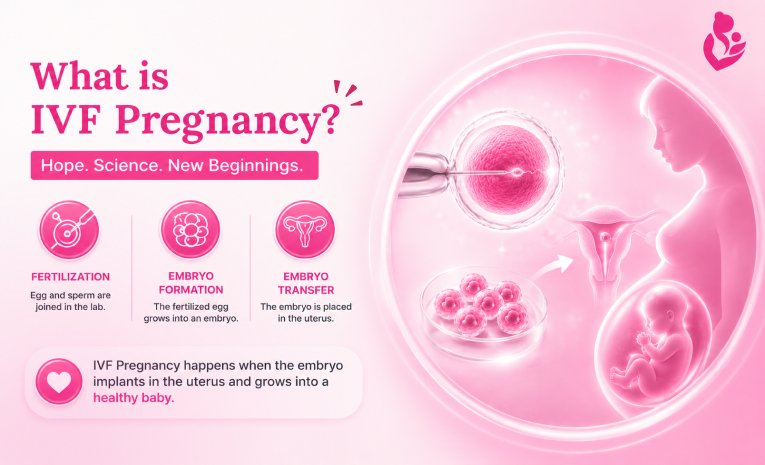
IVF pregnancy begins when a healthy embryo, created through In Vitro Fertilization (IVF) in a laboratory, is successfully transferred into the uterus and implants in the uterine lining. Once implantation occurs, the pregnancy progresses just like a natural pregnancy, with the embryo developing into a fetus over the following weeks.
How Does IVF Pregnancy Work? Step-by-Step
1. Ovarian Stimulation
- The IVF process starts with fertility hormone injections that stimulate the ovaries to produce multiple mature eggs instead of the single egg released during a natural menstrual cycle.
- Producing several eggs increases the chances of obtaining healthy embryos for transfer.
- During this phase, doctors closely monitor follicle growth using ultrasound scans and blood hormone tests.
- This stage usually lasts 8–14 days, depending on the patient’s response to the medications.
2. Egg Retrieval (Oocyte Pickup)
- Once the eggs reach maturity, a trigger injection is given to complete their final development.
- Around 34–36 hours later, the eggs are collected through a minimally invasive procedure performed under light sedation.
- A thin needle, guided by ultrasound, gently retrieves the eggs from the ovarian follicles.
- The procedure typically takes 20–30 minutes, and most women can return home the same day.
3. Fertilization in the Laboratory
- The retrieved eggs are combined with the partner’s or donor’s sperm in a specialized IVF laboratory.
- Fertilization may occur naturally in a culture dish or through Intracytoplasmic Sperm Injection (ICSI), where a single healthy sperm is injected directly into each mature egg.
- Embryologists carefully monitor the fertilization process to identify healthy embryos.
- Successful fertilization usually occurs within 16–18 hours after insemination.
4. Embryo Development
- The fertilized eggs, now called embryos, are cultured in advanced laboratory incubators.
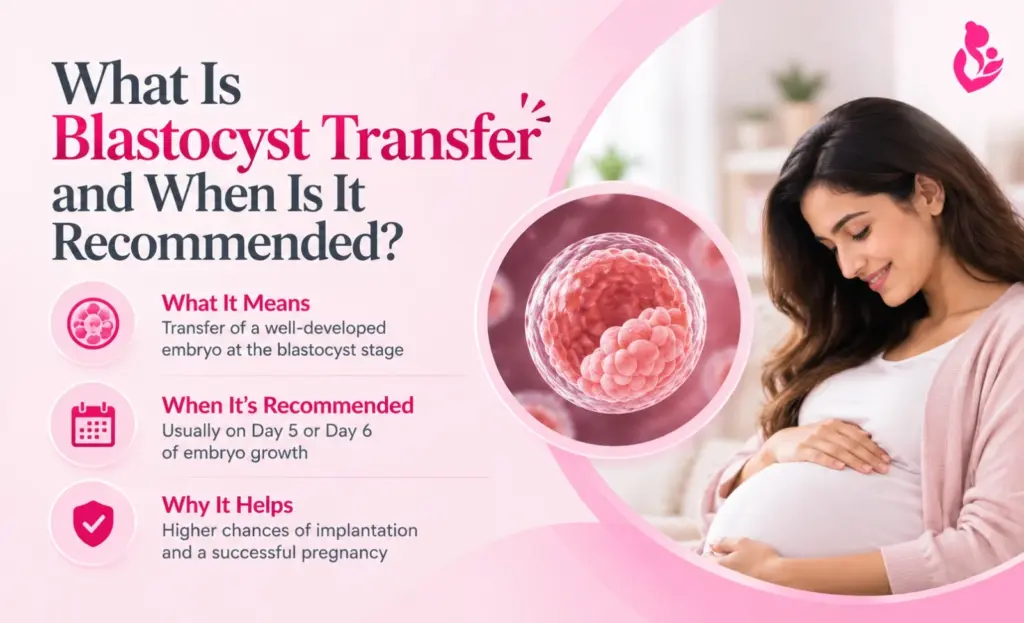
- Over the next 3–5 days, the embryos divide and grow into multicellular structures known as blastocysts.
- Specialists evaluate embryo quality based on cell division, appearance, and developmental progress.
- Only the healthiest embryos are selected for transfer or freezing.
5. Embryo Transfer
- A selected healthy embryo is placed inside the uterus using a thin, flexible catheter.
- The procedure is simple, painless for most women, and usually does not require anesthesia.
- Embryo transfer is one of the most important stages because it allows the embryo to reach the ideal environment for implantation.
- Most patients can resume normal daily activities shortly after the procedure.
6. Embryo Implantation
- After transfer, the embryo travels within the uterus and attaches to the endometrial lining.
- Successful implantation generally occurs within 6–10 days after egg retrieval or 1–5 days after embryo transfer, depending on the embryo’s developmental stage.
- Once implanted, the embryo begins forming the placenta, which supplies oxygen and nutrients throughout pregnancy.
- Implantation marks the beginning of an best ivf centre in gurgaon.
7. Pregnancy Hormone Production
- Following implantation, the developing embryo starts producing Human Chorionic Gonadotropin (hCG).
- This hormone supports the pregnancy and signals the body to continue producing progesterone, which helps maintain the uterine lining.
- Rising hCG levels are the earliest indicator of a successful pregnancy.
- Doctors often continue progesterone support during the first few weeks to improve implantation success.
8. Pregnancy Confirmation
- Around 9–14 days after embryo transfer, a Beta hCG blood test is performed to confirm pregnancy.
- If the test is positive, repeat blood tests may be done to ensure hormone levels are rising appropriately.
- An ultrasound scan is usually scheduled at 6–7 weeks to confirm the gestational sac, fetal heartbeat, and normal pregnancy development.
- From this point onward, an IVF pregnancy progresses similarly to a naturally conceived pregnancy, with routine prenatal care and regular medical check-ups.
IVF Pregnancy Success Rate
The success of IVF depends on multiple factors, particularly maternal age.
| Age Group | Average Success Rate per IVF Cycle |
| Under 35 years | 45–55% |
| 35–37 years | 35–45% |
| 38–40 years | 20–30% |
| Above 40 years | 5–15% |
Benefits of IVF Pregnancy
IVF pregnancy offers hope to individuals and couples facing infertility by providing one of the most effective assisted reproductive technologies (ART) available today. With continuous advancements in fertility treatment, IVF has helped millions of families successfully achieve pregnancy and parenthood.
- High Success Rates: IVF is one of the most successful fertility treatments, especially for women under 35 years of age and those with good-quality embryos.
- Treats Various Causes of Infertility: IVF can help overcome infertility caused by blocked fallopian tubes, male infertility, ovulation disorders, endometriosis, PCOS, unexplained infertility, and other reproductive conditions.
- Improves Chances of Pregnancy: By selecting healthy embryos for transfer, IVF significantly increases the likelihood of successful implantation and pregnancy compared to many other fertility treatments.
- Supports Male Infertility Treatment: Advanced techniques such as Intracytoplasmic Sperm Injection (ICSI) enable successful fertilization even in cases of low sperm count, poor sperm motility, or abnormal sperm morphology.
- Allows Genetic Testing of Embryos: IVF makes it possible to perform Preimplantation Genetic Testing (PGT), helping identify embryos free from certain inherited genetic disorders before transfer.
- Provides Fertility Preservation: Eggs, sperm, and embryos can be frozen for future use, making IVF an excellent option for individuals planning delayed parenthood or undergoing treatments such as chemotherapy.
- Offers Donor Egg and Donor Sperm Options: Individuals or couples who cannot conceive using their own eggs or sperm may achieve pregnancy through donor-assisted IVF.
- Helps Women with Blocked or Damaged Fallopian Tubes: Since fertilization occurs outside the body, IVF bypasses the fallopian tubes entirely, making pregnancy possible even when the tubes are blocked or surgically removed.
- Enables Parenthood for Diverse Families: IVF can help single parents by choice, same-sex couples, and individuals using donor gametes or gestational surrogacy build their families.
Risks and Complications of IVF Pregnancy
Although IVF pregnancy is generally safe and successful, like any medical treatment, it carries certain risks and complications that vary depending on the woman’s age, health, fertility condition, and the number of embryos transferred.
- Multiple Pregnancy: Transferring more than one embryo can increase the chances of twins or triplets, which are associated with a higher risk of premature birth, low birth weight, gestational diabetes, and pregnancy-related complications.
- Ovarian Hyperstimulation Syndrome (OHSS): Fertility medications may cause the ovaries to become swollen and painful, leading to symptoms such as abdominal bloating, nausea, vomiting, rapid weight gain, and fluid accumulation. Severe cases require immediate medical attention.
- Ectopic Pregnancy: In rare cases, the embryo implants outside the uterus, most commonly in the fallopian tube. This is a medical emergency that requires prompt treatment to prevent serious complications.
- Miscarriage: The risk of miscarriage after IVF is similar to that of natural conception and is influenced mainly by the mother’s age, embryo quality, and underlying medical conditions.
- Preterm Birth: IVF pregnancies, particularly multiple pregnancies, have a slightly higher chance of delivering before 37 weeks of gestation, which may require specialized neonatal care.
- Low Birth Weight: Babies born through IVF, especially twins or triplets, may have a greater likelihood of being born with a low birth weight due to premature delivery.
- Procedure-Related Risks: Egg retrieval is a minimally invasive procedure but may occasionally cause bleeding, infection, injury to nearby organs, or complications related to anesthesia.
- Emotional and Psychological Stress: The IVF journey can be emotionally demanding due to repeated treatments, hormonal changes, financial costs, and uncertainty about the outcome, making counseling and emotional support beneficial for many couples.
- Implantation Failure: Even when high-quality embryos are transferred, implantation may not occur because of factors such as embryo genetics, uterine receptivity, or hormonal imbalance.
- Pregnancy-Related Complications: Some IVF pregnancies may have a slightly increased risk of conditions such as high blood pressure, preeclampsia, placenta previa, or gestational diabetes, particularly in women with advanced maternal age or pre-existing health conditions.
- Birth Defects: The overall risk of congenital abnormalities remains low, and most babies conceived through IVF are born healthy. Any slight increase in risk is often linked to parental age or underlying infertility rather than the IVF procedure itself.
What Happens After IVF Pregnancy Is Confirmed?
Once an IVF pregnancy is confirmed through a positive Beta hCG blood test, the pregnancy is closely monitored during the first few weeks to ensure healthy embryo development. Your doctor may continue progesterone or other hormone medications to support the pregnancy and schedule regular ultrasound scans to confirm the gestational sac and fetal heartbeat. After the early stages, the pregnancy usually progresses like a natural pregnancy, with routine prenatal check-ups, a healthy diet, and standard maternity care until delivery.
What is IVF Pregnancy? FAQs
Can IVF babies be born naturally?
Yes. Many women who conceive through IVF can have a normal vaginal delivery if there are no pregnancy complications. The mode of delivery depends on the mother’s and baby’s health rather than the IVF procedure itself.
Is IVF pregnancy considered high-risk?
Not necessarily. IVF pregnancies may receive closer monitoring during the early weeks, especially for older mothers or those with underlying medical conditions. Many IVF pregnancies progress normally.
How soon can pregnancy be detected after IVF?
A blood Beta hCG test is typically performed 9–14 days after embryo transfer to confirm pregnancy.
Is bed rest required after embryo transfer?
Routine bed rest is generally not recommended. Most fertility specialists advise light daily activities while avoiding strenuous exercise and heavy lifting.
How many IVF cycles are usually needed?
Some couples conceive during the first cycle, while others may require multiple IVF cycles depending on age, embryo quality, and the cause of infertility.
Can IVF fail even with good embryos?
Yes. Even high-quality embryos may not implant successfully because implantation also depends on uterine receptivity, embryo genetics, hormonal balance, and other biological factors.